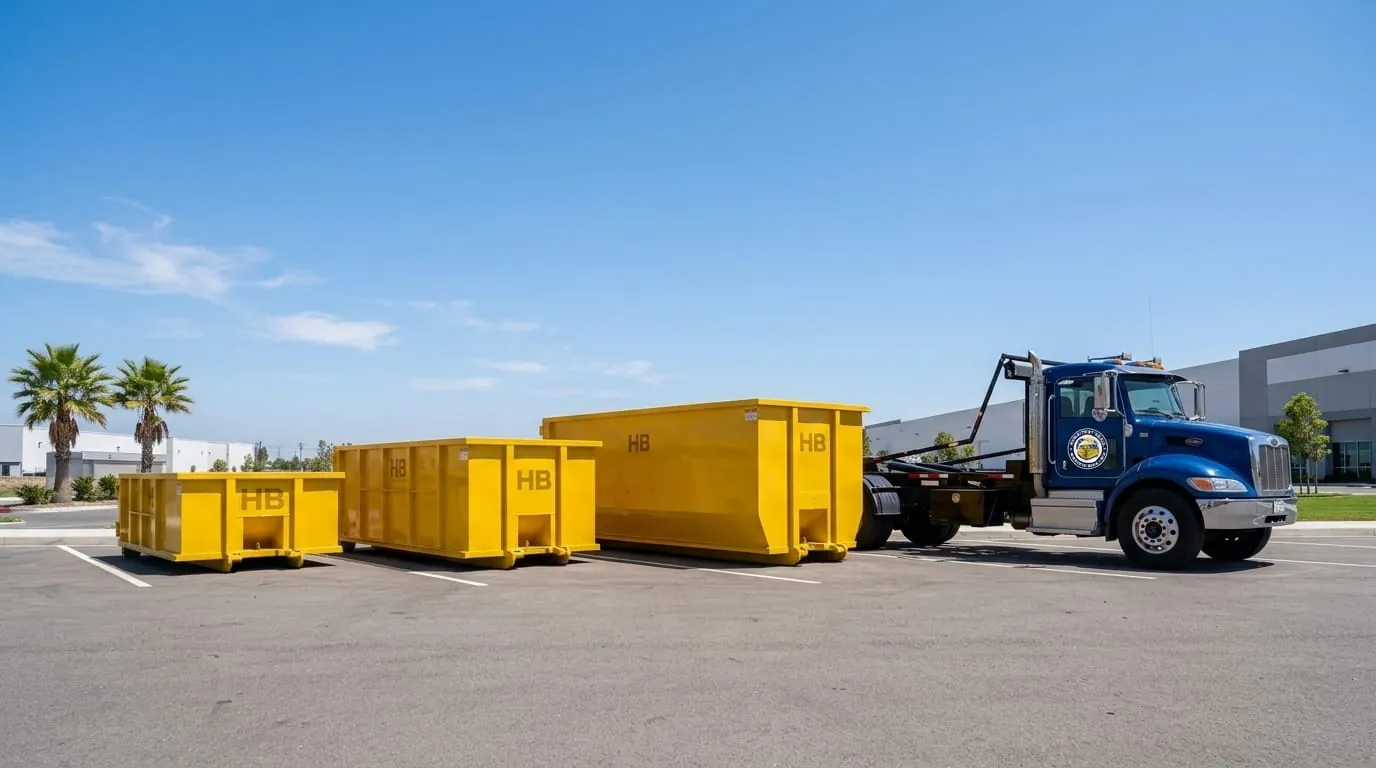
If you've ever stood in your Huntington Beach driveway staring at a pile of old cabinets, cracked tile, and yard waste wondering how big a bin you actually need, you're not alone. It's the single most common question we get on the phone. Order too small and you're paying for a second haul or an overage fee. Order too big and you've wasted money on air, plus you've got a giant steel box eating up your whole driveway for a week.
This guide walks you through the four sizes we run most often around HB and Orange County, what each one realistically holds, the projects they're built for, and the one factor most homeowners forget until it's too late: weight. Let's get you the right bin the first time.
The four sizes, at a glance
Dumpsters are measured in cubic yards, which describes volume, not weight. A "yard" is one cubic yard of space (3 ft x 3 ft x 3 ft). Here's how our common sizes compare, including roughly how many standard pickup-truck bed loads each one swallows.
| Size | Typical Dimensions (L x W x H) | Pickup Loads | Weight Limit (avg) | Best For |
|---|---|---|---|---|
| 10 yard | 12 ft x 8 ft x 3.5 ft | ~3 loads | 1–2 tons | Small remodels, heavy debris (concrete, tile, dirt) |
| 15 yard | 16 ft x 8 ft x 4 ft | ~4–5 loads | 2–3 tons | Bathroom/kitchen remodels, medium cleanouts |
| 20 yard | 22 ft x 8 ft x 4.5 ft | ~6 loads | 3 tons | Whole-home cleanouts, flooring, roofing |
| 30 yard | 22 ft x 8 ft x 6 ft | ~9 loads | 4–5 tons | New construction, additions, large demo |
Dimensions vary a little by manufacturer, but these are close to what actually shows up on your driveway. Notice that the 20 and 30 yard share a footprint — the 30 is just taller. That matters more than you'd think, which we'll get to.
Rule of thumb: when you're between two sizes, size up for light bulky junk (furniture, cardboard, drywall) and size down for heavy dense debris (concrete, tile, dirt, roofing).
The 10-yard: small footprint, heavy-duty jobs
The 10-yard dumpster is our smallest and, for a lot of HB homeowners, the smartest choice. It holds about three pickup-truck loads and, at roughly 12 feet long, it tucks neatly into even a tight beach-lot driveway without blocking the garage or spilling onto the street.
Here's the thing most people miss: the 10-yard is the go-to for heavy material. If you're tearing out a concrete patio, ripping up old bathroom tile, or hauling off dirt from a landscaping project, you will hit the weight limit long before you fill the box. Concrete is deceptively dense — a 10-yard bin half full of broken concrete can already weigh close to two tons. That's exactly why we steer concrete, brick, and tile jobs toward this size instead of a bigger one you'd never be able to legally fill.
Good SoCal projects for a 10-yard
- Small condo bathroom demo (tile, tub, vanity)
- Concrete or paver patio removal
- Garage cleanout for a smaller unit
- A weekend of yard and green-waste clearing
The 15-yard: the remodel workhorse
The 15-yard dumpster is the size we most often recommend for a single-room remodel. It handles four to five pickup loads — enough for a full bathroom gut or a mid-size kitchen refresh without paying for volume you won't use.
Picture a typical Huntington Beach bathroom remodel: you're pulling out a vanity, a tub, tile surround, drywall, and old fixtures. A 10-yard might come up short once you add the packaging from your new materials; a 20-yard would leave you staring at a half-empty box. The 15 hits the sweet spot. It's also still compact enough (about 16 feet) to fit comfortably on most HB driveways without you having to pull a street permit.
Good SoCal projects for a 15-yard
- Full bathroom or small kitchen remodel
- Single-room flooring replacement
- Medium garage or estate cleanout
- Deck teardown (wood, not concrete footings)
Not sure whether your job is a 10 or a 15? That's a two-minute phone call. Give us a quick rundown of what you're tossing and we'll tell you straight. Call (714) 475-1269.
The 20-yard: whole-home projects and roofing
The 20-yard dumpster is our most popular all-around size. At roughly six pickup loads, it's big enough for serious projects but still has that lower 4.5-foot wall height, which means you can walk debris in over the side or use the swing door instead of heaving everything up and over.
This is the size for a whole-home cleanout — think clearing out a family home in a HB neighborhood before a sale, or a big garage-plus-attic purge. It's also the standard pick for roofing tear-offs. A single-layer asphalt shingle roof on an average home fits well in a 20-yard, though remember that old shingles are heavy, so on a two-layer tear-off we may talk you into splitting the load or watching the weight limit closely.
Good SoCal projects for a 20-yard
- Whole-home or large estate cleanout
- Single-layer roof replacement
- Flooring across a whole house
- Large landscaping overhaul (mixed green and bulky waste)
The 30-yard: construction and major demo
The 30-yard dumpster is the big one — about nine pickup loads. Remember how it shares a footprint with the 20-yard but stands six feet tall? That extra height is pure bonus volume for light, bulky material, which is exactly what construction and large demo jobs produce: framing lumber, drywall, insulation, cardboard, and packaging.
This is the size for a new-construction build, a home addition or ADU, or a gut renovation where walls are coming down. What the 30-yard is not for is heavy debris. Fill a 30 with concrete or dirt and you'll blow past the weight limit while the box is barely a third full — and then it's too heavy for the truck to legally haul. Keep the heavy stuff in a 10-yard and save the 30 for volume.
Good SoCal projects for a 30-yard
- New construction or ADU build
- Home addition or major renovation
- Large multi-room demolition
- Commercial cleanout or big move-out
The two mistakes we see most
1. Renting too big "just to be safe"
Bigger isn't safer — it's usually just more expensive. If your debris is heavy (concrete, tile, dirt, roofing), a huge bin does you no good because you'll hit the weight cap with the box half empty. And on a tight HB beach lot, an oversized bin can block your garage or force a street-placement permit you didn't need. Match the size to the weight of your material first, then the volume.
2. Renting too small and paying twice
On the flip side, ordering a 10-yard for a full-home cleanout means a second haul, a second drop fee, and lost time. When your material is light and bulky, err toward the larger size. The cost difference between a 15 and a 20 is far less than the cost of a whole extra pickup.
A quick note on HB driveways and access
Huntington Beach lots, especially down near the water and in the older neighborhoods, can have short, narrow driveways. All of our bins fit standard driveways, but the smaller 10 and 15 yard footprints give you the most breathing room — you can often still get a car past or keep the garage usable. We always lay down boards to protect your concrete or pavers, and if street placement is your only option, we'll walk you through the city permit before drop-off.
Before we deliver, clear about 60 feet of straight approach for the truck, and make sure no low branches or wires hang over the drop spot. A two-minute walk-through of your driveway on the phone saves headaches on delivery day.
Still not sure? Just ask a local
You don't need to become a dumpster expert. Tell us what you're working on — the project, the rough amount of debris, and whether it's heavy or bulky — and we'll match you to the right size in one call. We know HB driveways, Orange County dump rules, and how to keep you from paying for a bin you don't need.
Call Huntington Beach Dumpster Rental Guys at (714) 475-1269, or reach out through our contact page for a fast quote. We'll get the right bin in your driveway and out of your way.

Founder, Huntington Beach Dumpster Rental Guys — sharing straight advice from more than 15 years of local hauling experience.