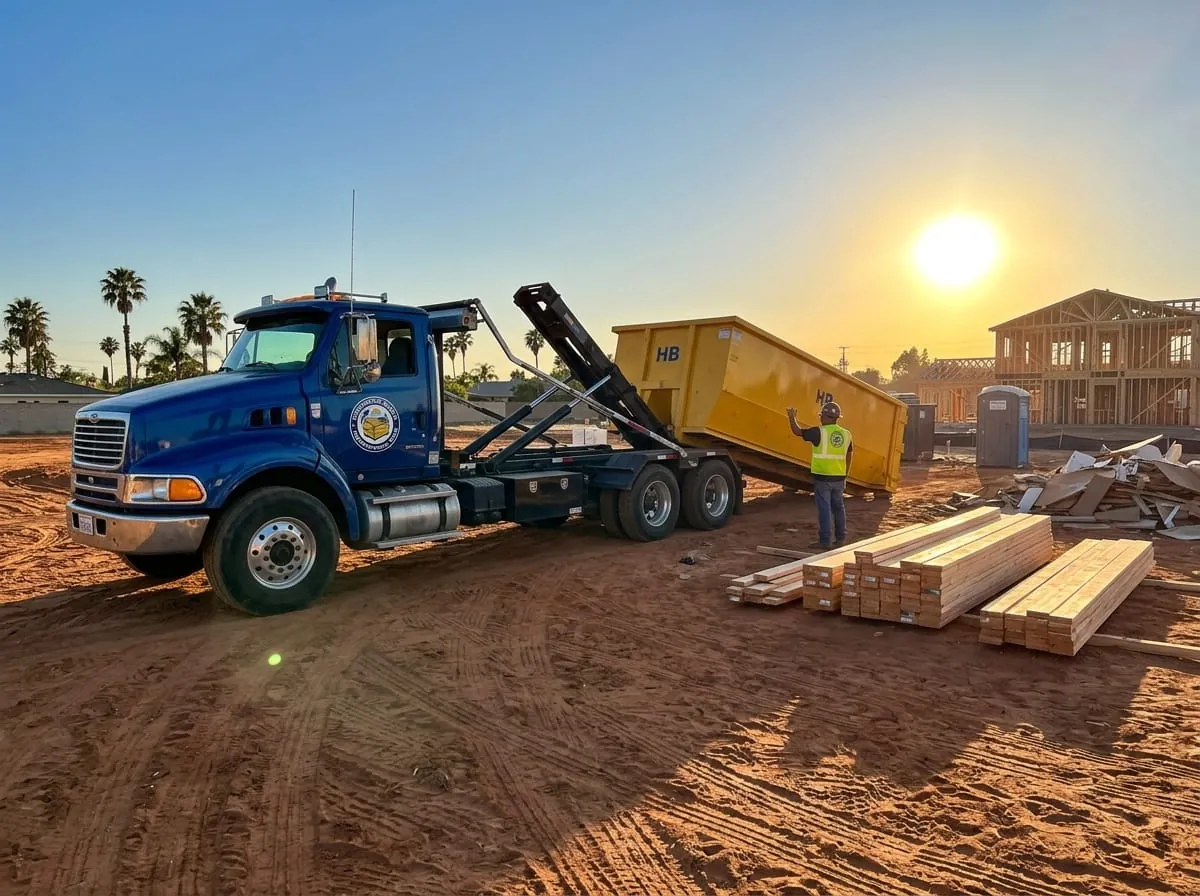
If you have ever watched a tear-off crew work a Huntington Beach roof, you know the debris comes down fast. What surprises most homeowners is not the volume of that pile in the driveway. It is the weight. Roofing debris is one of the densest loads we haul, and misjudging it is the single most common way people blow their budget on a roofing dumpster in Huntington Beach. This guide walks through how we size roofing bins by squares and layers, why a tile roof plays by completely different rules than asphalt, and how to keep your bin close to the work without cracking the driveway.
Why Shingle Debris Is So Deceptively Heavy
A dumpster looks half empty and people assume they have room to spare. Then the truck can't lift it. Asphalt shingles are made of a fiberglass or felt mat saturated with asphalt and coated in mineral granules. That granular, tar-soaked material is dense, and once you tear off an old roof, especially one that has soaked up years of coastal moisture and marine layer humidity, every bundle weighs more than it looks.
Roofers measure a roof in squares. One square equals 100 square feet of roof surface. For planning a dumpster, the rule of thumb we use in Orange County is that a single layer of asphalt shingles runs roughly 200 to 250 pounds per square. That number matters because it means volume is almost never your limiting factor on a roofing job. Weight is.
A 10-yard dumpster that looks two-thirds empty can already be at its legal road weight if it's packed with wet asphalt tear-off. On roofing jobs, we fill by the ton, not by the eyeball.
Layers change everything
Here's the detail people forget: many older Huntington Beach homes have a second or even third layer of shingles that a previous owner laid right over the old roof instead of tearing off. If you are pulling two layers, you double the weight. Three layers, you triple it. Before you book anything, get up in the attic or ask your roofer to check the roof edge and count the layers. That single number will change which bin you need more than the square footage will.
Tile and Clay Roofs: A Different Animal
Southern California is full of tile. Drive any HB neighborhood and you'll see clay barrel tile, concrete flat tile, and the terracotta-look profiles that define so much of the SoCal aesthetic. If you are tearing one of those off, throw the asphalt numbers out the window.
Concrete tile runs somewhere around 900 to 1,000 pounds per square. Clay tile is often heavier still. That is roughly four to five times the weight of a single layer of asphalt. A tile tear-off that covers the same roof area as an asphalt job can produce a load that weighs four times as much, even though the pile in the driveway might not look dramatically bigger.
This is exactly why we always ask what kind of roof you have before we quote a roofing dumpster rental. "20 squares" tells us the area. "20 squares of concrete tile" tells us we are dealing with something close to ten tons of debris, and that changes the conversation entirely. Tile also can't be crammed the way shingles can, and broken tile has sharp edges that make hand-loading slower, so plan your labor accordingly.
Why a Smaller Bin Kept Within Weight Beats an Oversized One
Instinct says: get the biggest dumpster so you never run out of room. On roofing, that instinct works against you.
Every dumpster comes with an included weight allowance. Go over it and you pay overage fees by the ton, which is where roofing budgets quietly explode. Because roofing debris is so dense, you will almost always hit the weight cap long before you fill the box. A bigger box does not raise your weight allowance in a way that helps, and it costs more up front, takes more driveway space, and tempts your crew to keep piling material into a bin that is already too heavy to legally haul.
The smarter play for a mid-size tear-off is often a well-matched 15-yard dumpster or even a compact 10-yard dumpster, which have lower profiles and a heavier-duty build suited to dense loads. For a large or a tile job, two smaller swaps, hauling one away and dropping another, is frequently cheaper and always safer than one giant bin you can't fully load. We would rather you call and swap than eat an overage fee, and we can usually turn a swap around same day here in HB.
Not sure how the general sizing logic works? Our guide to what size dumpster you need covers the volume side. For roofing, just remember to let weight be the deciding vote.
Roof size to suggested bin
Use this as a starting point for asphalt tear-off. For tile or clay, drop down a roof-size row or plan on multiple hauls, because the weight roughly quadruples.
| Roof size (asphalt) | Layers | Suggested bin | Notes |
|---|---|---|---|
| Up to 15 squares | 1 layer | 10-yard | Garages, small ranch homes; keep it within weight. |
| 15 to 25 squares | 1 layer | 15-yard | Most single-story HB homes. |
| 15 to 20 squares | 2 layers | 15-yard | Two layers doubles the weight; don't oversize. |
| 25 to 40 squares | 1 to 2 layers | 15-yard + swap | Two hauls beat one overloaded box. |
| Any tile / clay roof | 1 layer | 10-yard (plan swaps) | ~4x asphalt weight; call us to plan hauls. |
These are guidelines, not guarantees, because layer count and moisture change the math. When in doubt, tell us the squares, the layers, and the roof material, and we will size it for you. Call (714) 475-1269 and we'll match the bin to your actual load.
Placing the Bin Close to the Work, on Boards
On a tear-off, every foot between the roof and the bin is a foot your crew carries or throws heavy debris. Position the dumpster as close to the eave and the tear-off zone as your driveway allows, ideally where roofers can shovel or slide material straight in or run a debris chute into it.
Protect your surface. A loaded roofing dumpster is heavy, and the wheels and delivery process can mark or crack a driveway. We lay down boards or plywood under the bin's contact points to spread the load and protect concrete, pavers, and asphalt. If you have a decorative driveway or fresh sealcoat, tell us when you book so we plan the drop accordingly. In tighter HB lots and alley-access properties, a smaller bin is often the only thing that physically fits close to the work anyway, which is another point in favor of right-sizing over oversizing.
Working With Your Roofer and Avoiding Overage Fees
Good roofers have loaded a thousand dumpsters and usually know roughly what a job will weigh. Loop them in early. A few things that keep costs down:
- Confirm who books the bin. Some roofers include disposal; some expect you to arrange it. Nail this down before day one.
- Load evenly and flat. Spread debris across the floor of the bin rather than mounding it. It rides safer and stays legal for the road.
- Keep it roofing-only. Don't toss in general junk, dirt, or concrete. Mixing materials into a weight-limited roofing load is a fast way into overage territory.
- Don't tear off in the rain if you can help it. Wet shingles are meaningfully heavier. On a marine-layer morning, let it dry off first.
- Call for a swap before it's overloaded, not after. We would rather bring a fresh bin than have a truck unable to lift yours.
That's the whole game with a roofing dumpster: respect the weight, count your layers, know your roof material, and put the bin where the work is. Do that and you'll spend on the roof, not on surprise fees.
Planning a tear-off in Huntington Beach or anywhere in Orange County? Tell us your squares, layers, and roof type, and we'll size it right the first time. Call Huntington Beach Dumpster Rental Guys at (714) 475-1269 or reach out through our contact page for a straight answer on the right bin for your roof.

Founder, Huntington Beach Dumpster Rental Guys — sharing straight advice from more than 15 years of local hauling experience.